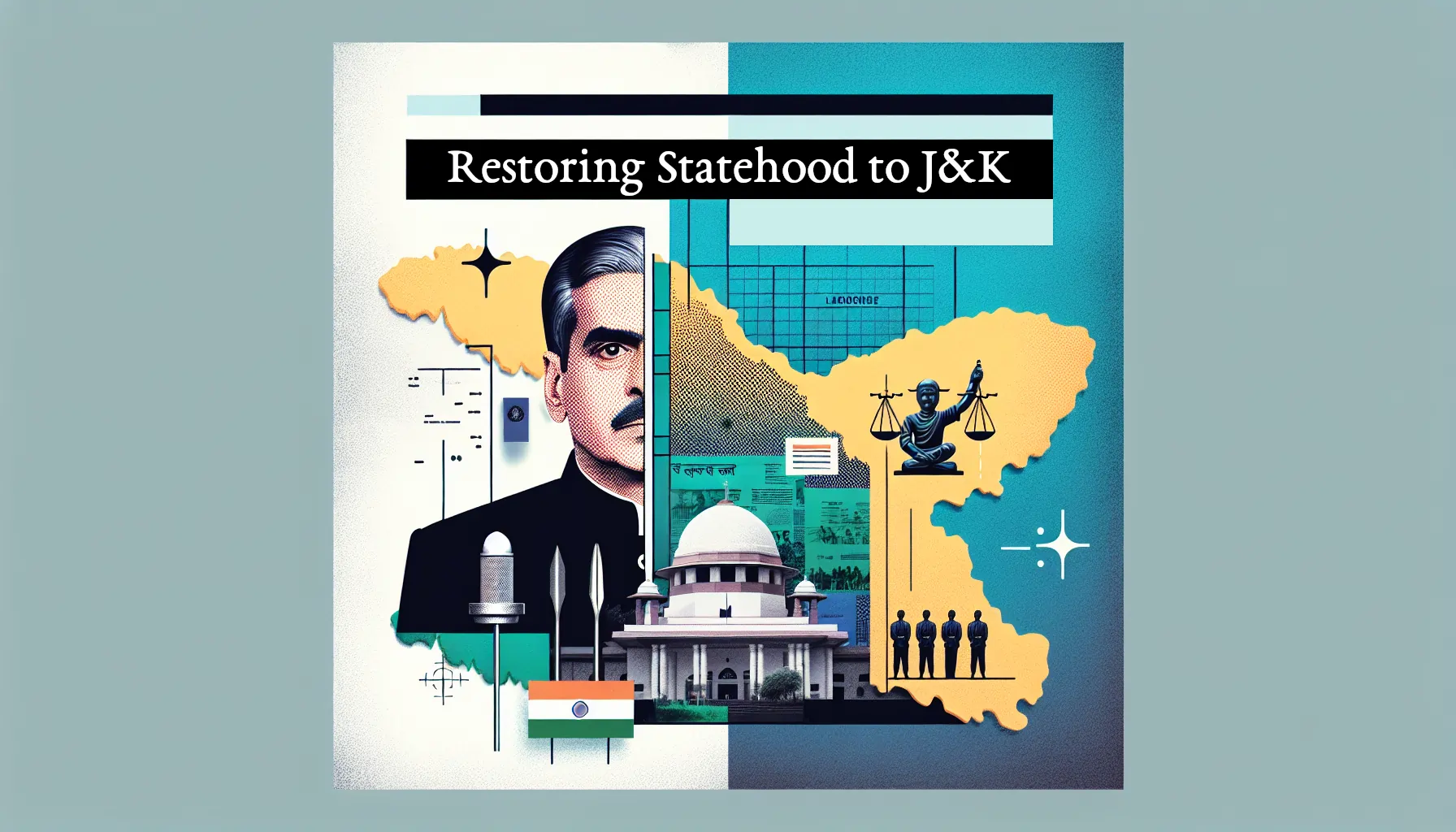
Omar Abdullah, the Chief Minister of Jammu and Kashmir, has been vocal about the restoration of statehood to the region, which was downgraded to a Union Territory (UT) in August 2019 following the abrogation of Article 370. This significant political shift has led to ongoing discussions about governance and the rights of the people in Jammu and Kashmir. Abdullah’s government, formed after the 2024 Assembly elections, has emphasized that the current UT status is temporary and that restoring statehood is a primary objective.
He has pointed out that the Supreme Court has urged the central government to expedite this process, suggesting that one year since the court’s directive should be sufficient for action. Abdullah has also highlighted the challenges posed by the dual power structure in the region, where significant authority remains with the Lieutenant Governor, complicating effective governance. His administration has initiated steps to fulfil electoral promises, including a resolution for statehood restoration passed in the first Cabinet meeting.
However, Abdullah faces internal party dynamics, particularly with National Conference MP Aga Ruhullah Mehdi, who strongly focuses on restoring Article 370 rather than merely seeking statehood. This reflects a broader sentiment among some party members that the push for statehood should not overshadow the fight for special status.
Jargon
- Statehood: The status of Jammu and Kashmir as a full-fledged state with its own legislative assembly and greater autonomy, which was revoked in 2019 when it was reorganized into a Union Territory.
- Union Territory (UT): A type of administrative division in India that is governed directly by the Central Government, with limited powers compared to a full state.
- Article 370: A provision in the Indian Constitution that granted special autonomy to Jammu and Kashmir, which was abrogated in August 2019, leading to significant political and social changes in the region.
- Lieutenant Governor: The representative of the Central Government in a Union Territory, who holds significant powers, often leading to a dual power structure in governance, as seen in Jammu and Kashmir.
- PoK: Pakistan-occupied Kashmir, referring to the part of the former princely state of Jammu and Kashmir that is administered by Pakistan, often mentioned in discussions about the unresolved Kashmir issue.
Viewpoints 💭
- The left views the restoration of statehood as a necessary step to reclaim the democratic rights and identity of Jammu and Kashmir, which were undermined by the abrogation of Article 370.
- They emphasize the importance of addressing the aspirations of the people of Jammu and Kashmir, advocating for a governance model that respects local autonomy and democratic processes.
- The left criticizes the dual power structure in the Union Territory, arguing that it hampers effective governance and undermines the authority of the elected government.
- They highlight the need for a single command structure to ensure efficient governance and address issues like unemployment, power distribution, and infrastructure development.
- The left supports Omar Abdullah’s efforts to engage with the central government for statehood restoration, viewing it as a step towards healing and reclaiming constitutional rights.
- The left emphasizes the restoration of statehood as a means to reclaim democratic rights and local autonomy, while the right views the current Union Territory status as necessary for national integration and security.
- The left criticizes the dual power structure in Jammu and Kashmir, advocating for a single command structure to ensure effective governance, whereas the right supports central oversight to maintain stability and counter-terrorism efforts.
- While the left views the restoration of Article 370 as integral to addressing the aspirations of the people, the right considers it a distraction from development and integration into the national framework.
- The left supports engaging with the central government for statehood restoration as a step towards healing and reclaiming constitutional rights, while the right emphasizes a cautious approach to statehood restoration, considering security and reform needs.
- The left highlights the need for addressing local issues like unemployment and infrastructure development through statehood, whereas the right focuses on leveraging the Union Territory status for implementing development projects and improving governance.
- The right views the abrogation of Article 370 and the subsequent reorganization of Jammu and Kashmir as necessary measures for national integration and security.
- They emphasize the importance of maintaining a strong central oversight in the region to ensure stability and counter-terrorism efforts.
- The right supports the current Union Territory status as a means to implement development projects and improve governance in Jammu and Kashmir.
- They argue that the restoration of statehood should be approached cautiously, considering the security situation and the need for comprehensive reforms.
- The right criticizes the focus on Article 370 restoration, viewing it as a distraction from the region’s development and integration into the national framework.
Prominent Voices 📣
- Omar Abdullah (Chief Minister of Jammu and Kashmir): Advocates for the restoration of statehood to Jammu and Kashmir, emphasizing it as a temporary Union Territory status and highlighting the central government’s promise to restore it, while also addressing governance challenges and maintaining a constructive relationship with the Centre.
1
2
- Farooq Abdullah (Former Chief Minister of Jammu and Kashmir): Highlights the importance of resolving everyday issues over the immediate restoration of Article 370.
3
4
- Aga Ruhullah Mehdi (National Conference MP from Srinagar): Prioritizes the restoration of Article 370 over statehood, expressing readiness to protest for statehood in Delhi and emphasizing the need to fight for Jammu & Kashmir’s special status and dignity.
6
- MY Tarigami (Kulgam MLA and CPM leader): Stresses the importance of the Union Government honoring its commitments to restore statehood, highlighting the disempowerment of the Assembly under the current status.
7
- Mohamad Yousuf Tarigami (CPM MLA): Expresses concerns about the dual power structure and its impact on legislative clarity.
- Amit Shah (Union Home Minister): Engages in discussions about the urgent need for statehood and addresses security challenges in Jammu and Kashmir, emphasizing a strong stance on national security.
9
- Manoj Sinha (Lieutenant Governor of Jammu and Kashmir): Clears the resolution for statehood restoration, emphasizing the protection of identity and constitutional rights, while reflecting a different ideological stance from the National Conference.
- Sunil Sethi (BJP spokesperson): Warns against hasty decisions on statehood restoration, highlighting the need for careful consideration of all factors.
13


